Gabriel Lewis
Level Design
Boltgun - Fan Blockout
Level Montage
Level Overview
The level is based on Auroch Digital's (Warhammer 40K) Boltgun.
Boltgun is a first person retro shooter.
Engine: Unreal 5, Blueprints
Documentation: Word
3D Assets: Blender
Narrative Overview
‘A Bloody Great Escape’ could take place around three quarters of the way through chapter one. The player has been captured at the end of the previous level and has been left unconscious surrounded by the bodies of fallen comrades. This could act almost as a ‘low’ point for the player – turning the final levels into more of a comeback story, fighting against the odds to win.
What I did:
- Created a level document that highlighted each area, providing references, and details.
- Created all 3D assets using Blender.
- Laid out the geometry, and space of the level using the Blockout Tool plugin.
- Used blueprints, programmed all doors, pickups, lifts, different enemies, and sound effects.

Documentation
Design Document Link: https://drive.google.com/file/d/1uQkMAIMb2Dv8xckfCQ6SUZ58t0AG0-g4/view?usp=drive_link
For the documentation I decided that I would use the advice of Level Designer Samuel Harden in order to create a document that could be used by a full team of designers, artists, and programmers.
The document involved outlining where the level took place within the game. Where the level was set, and the goals of the level.
These aspects were then broken down into individual areas that had their own reference images and relevant goals and details.
Level Design
The aim of this project was to receive iterative feedback in order to effectively Through the process of creating the level I was receiving feedback that allowed me to quickly iterate and improve the level in order to create a fun and engaging experience.

Landmarks and Distant Goals
LEVEL KEY POINTS
Throughout the level I wanted to maintain some key points that I could keep referring back to in order to make sure that the level was delivering the desired experience.
These points were:
- Verticality - With the player having no fall damage and a generous jump ability, I thought that playing with verticality would be an interesting element that could allow the player to move and flow round certain areas of the map.
- Less Cover - Due to the fast paced nature of the game (and again the movement mechanics), I wanted to encourage the player to keep moving, especially in combat scenarios. This meant that I would use cover sparingly in open arena style fights - preventing the player from stopping for too long to take cover.
- Room Objectives - Each room would have its own micro goal - whether that is collecting a key, or defeating a certain amount of enemies, each area needed to feel like it had a purpose and objective.

Verticality and Less Cover

Arena Style Area

Door Objective
ITERATION
Throughout the blockout process I was receiving updates and advice about how I could improve the map and bring it to be more in line with the actual game.
This led to many iterations and changes throughout the development of the map.
Here are a few:

Ammo Placement Balance
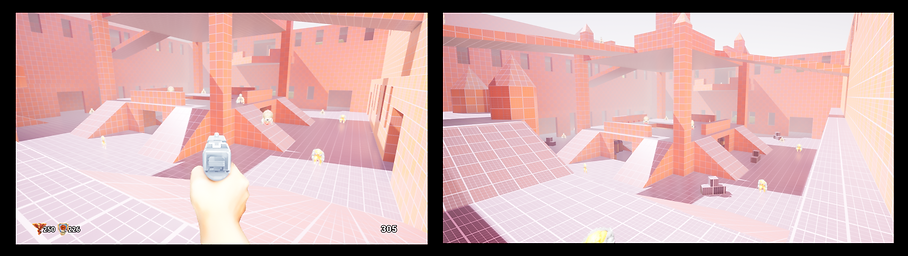
Added Movement Blockers (to break up players path)

Alter Symmetrical Buildings

Make The Final Door More Obvious

First Weenie

Motivate Movement
Full Walkthrough