Introduction
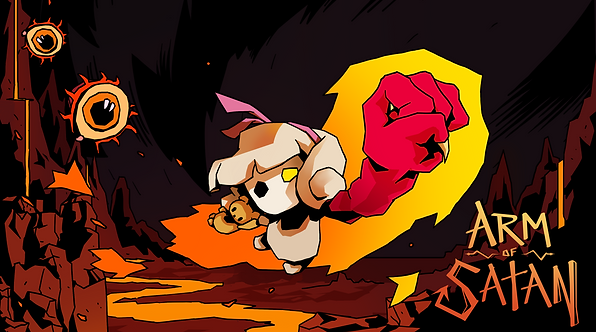
Arm of Satan is tough 2D co-op platformer, with art styles inspired by Mike Mignola's Hell Boy comics, and gameplay inspired by both classic and modern platformers alike.
Arm of Satan Follows the journey of two characters: Girl and Arm.
Girl controls like a classic platformer, in charge of movement and jumping.
Arm is an action oriented reflex machine: grabbing, throwing, and punching everything.
Players must work together to navigate the hellscapes that stands between them and their freedom.

My Role
Within the team I am the sole level designer. I am responsible for the conceptualisation, layout, blockout, and iteration of each level.
In addition to this, I am also called upon for general design work. Helping decide the gameplay mechanics, desired level mechanics, and overall game feel.
On a daily basis I work closely with artists, writers, programmers, and fellow designers in order to create fun and engaging levels, that highlight the mechanics and leave lasting impressions on those who play the game.


Level Inspiration
Throughout pre-production I spent a large amount of time researching, playing, and watching other top level platformers in order to see how other developers had created the levels for their own games.
I thought that I would highlight some of these games, and how they influenced my own level design in order to show my rationale, as well as providing a starting point for any future developers who decide to make their own top level platformer.
It Takes Two (Hazelight Studios, 2021), Character Abilities
With Arm of Satan being a co-op platformer I decided a good place to start with research would be to look at how It Takes Two (2021) balances their co-op mechanics. I found that throughout the game, whenever the characters received an ability, they would be provided with their own mechanical niche. These niches would rarely cross over, and the challenges throughout the level would often require both niches to complete. This meant that both characters were always engaged at every point in the game, and team work was crucial.
This method was implemented within Arm of Satan. When designing the individual characters abilities it was crucial that there was no overlap, especially due to both players occupying aspects of the same character. This led to Girl being primarily responsible for movement, and Arm being responsible for combat and defence, with some minor overlap, both had their own niche.
Hollow Knight (Team Cherry, 2017), Atmosphere and Pacing
Arm of Satan is best described as a tough co-op precision platformer. This involves many moments of high octane gameplay that test players skills and communication. In order to make these moments significant, and to avoid tedium, it is important to provide the player with slower paced sections of the level where they can relish in the environment and atmosphere created by the artists.
Hollow Knight (2017) does this incredibly well. With the rich environments and interactable elements scattered throughout, the player can really enjoy the slower pace in between combat and platforming. Not only can the player bask in the atmosphere around them, and appreciate the quality of the artwork, but the slower pace also helps contrast the next platforming or combat stage. These slower paced sections are very often seen just before boss fights. This really heightens the impact of each boss encounter.
Celeste (Maddy Makes Games, Extremely OK Games, Ltd, 2018) & Super Meat Boy (Team Meat, Blitworks, Ratalaika Games S.L., Woblyware, Woblyware Oy, 2010), Challenges
When showing Arm of Satan off at expos or events we are often asked if Celeste (2018) or Super Meat Boy (2010) were inspirations for the game. Our answer is always the same: Absolutely! Both of these games are our references for tough precision platformers. The fast repetitive nature of each of the challenges is exactly what we strive for in our own challenges. It was mentioned in a GDC talk given by the lead developer for Celeste (2018), Matt Thorson (https://www.youtube.com/watch?v=4RlpMhBKNr0&t=479s), that the deaths in Celeste (2018) were supposed to not be too punishing. This encouraged that fast paced gameplay, and keeps the players trying time after time in order to complete the challenge due to the setback not being too great.
Super Meat Boy (2010) similarly has shorter levels (especially towards the start of the game), this leads to the player giving the level 'just one more go' several times over because the death wasn't too punishing, and the levels all feel achievable. In addition to this, the replay feature makes finishing the level even more entertaining as you watch all your past attempts get splattered across the level.
We took this mentality and applied it to our own challenges in Arm of Satan. By using checkpoints throughout the level I was able to create short challenges where failure didn't feel like a massive set back. Matt Thorson also mentions in his GDC talk that he likes to think of the levels in Celeste (2018) like stories for the player to complete. I took this idea as well, and applied it to the challenges in Arm of Satan. Each challenge felt like a short story with a micro structure that the player could play through, and if they failed along the way it wasn't that much of a set back.
Donkey Kong Country: Tropical Freeze (Retro Studios, 2014) & Rayman Legends (Ubisoft, Ubisoft Montpellier, Pastagames, 2013), Mechanics and Level Identity
Towards the start of our pre-production we were trying to figure out how to add depth to the gameplay. We initially started by adding more upgrades that the players could unlock for each character, however this led to the characters feeling too complicated to control, and many platforming solutions were made redundant because the new upgrades removed restrictions on movement.
Donkey Kong Country: Tropical Freeze (2014) held the answer for this problem. I was pointed in the direction of Donkey Kong by my producer who wanted me to look at the platforming for reference. Watching how the levels were structured led to the realisation that instead of updating the characters abilities, we could instead change the level mechanics for each level. This could mean that the characters mechanics would have to be used to solve multiple puzzles and challenges, re-framing how the player uses those mechanics, building upon their understanding and mastery of the game.
Ensuring that each level had its own key mechanic helped us to not only keep the levels feeling fresh, but also allowed each level to have its own identity. After creating a few levels my design lead informed me that they all felt rather similar, and the mechanical difference I had chosen them wasn't enough to set them apart. He stressed the importance of having an identity for each level so players could easily identify and refer back to them, making the game stick in their heads. For example players could say: "Did you play the one with giant lava buckets" or " The lava slide level". Rayman Legends (2013) does this very well. By having set pieces, or staged events, there was always something in the level that gave it an identity. This led to players being able to quickly refer back to the level and relive part of the experience of playing it. Going forward we started to do the very same in Arm of Satan.


Level Design Philosophy
For Arm of Satan I have collected and combined philosophies from across the gaming industry. I use these philosophies as pillars for creating each level. They provide me with constant points to check back on in order to stay on track with my level production.
Kishotenketsu
A design philosophy taken from Chinese poetry and Japanese comics by Nintendo's Koichi Hayashida. This philosophy was highlighted in a video by journalist Mark Brown in his video about Super Mario 3D World (2021) (https://www.youtube.com/watch?v=dBmIkEvEBtA&t=129s). Essentially the philosophy is a four act structure that can be used to introduce new mechanics in a level. This is very useful for Arm of Satan due to each level having new mechanics for the players to interact with. Step 1: Introduce the mechanic in a safe environment. Step 2: Develop the concept without the safety net. Step 3: Add a twist (I tend to combine the multiple mechanics of the level). Step 4: Conclusion, a simple challenge that allows the player to enjoy the mastery of the mechanic.
Platforming Is Always Achievable With Room
This philosophy came about after having players play test some of the early levels within the game. At the start of pre-production I was trying to figure out how to manage difficulty. One of my go to ways of managing difficulty was distance between the platforms. This was OK in some areas, however, I started to use this method for all levels. Each platform was only reachable if the players perfectly timed the jump. This often led to tedium as the players kept on failing at the very first hurdle, or felt it unfair that they were so close to landing the jump but just couldn't quite make it. This led me to making it a rule that all platforms should be comfortably in range, and that difficulty shouldn't come from how far the platforms are from one another.
Both Players are Engaged, Unless Designed Otherwise
Stemming from the same issue that required each character to have their own niche, making sure that both players are engaged, and not being carried by one another is crucial for the gameplay. This has led to many mechanics throughout the levels requiring both players to perform an action in order to interact with the mechanic.
Process
When it comes to creating a level for Arm of Satan the process starts with the Level Design Document (LDD).
I decided to host the LDD on Miro so that each discipline could add what they want to happen in the level. I decided that the document should provide an area for the narrative team to write down the key events of what happens in the narrative throughout the level. Additionally I created areas for the main mechanics of the level, the current player mechanics, and the enemies that will be introduced in that level. With all this information I can then make informed decisions about how the level should be structured. This allows me to then tie in the level flow with the narrative, and plot out how different mechanics will be introduced and expanded throughout the level.
I can then take this information and start to fill out the LDD. This includes the level flow (what major events, challenges, and puzzles happen in the level), the level intensity graph

Live Level Design Document - Level flow, reference images, narrative beats, mechanics


Live Level Design Document - Level flow, reference images, narrative beats, mechanics (Close)
Once the level flow is completed I move into engine and start to roughly blockout the main shape of the level, adding text into certain areas to inform the other disciplines that something important happens in that area.
After the black blocks have been laid out and the rough shape of the level is complete I can then start to add functionality to the level. At this stage I work closely with our technical designer who can prototype the mechanics, or take my prototype mechanics and polish them. This leads to a functioning level with the main mechanics, enemies, and pickups placed throughout.

A Level Before Art Pass
Testing and iteration follows after the initial blockout. At this stage the level is tested internally by myself and other designers, then it is passed on to external testers and other members of the team. At this stage the level goes through many variations, and is modified until we are happy with the flow and how the level plays.
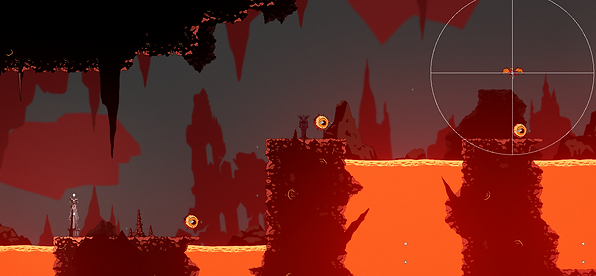
With the all clear from myself and the design team the level is then handed over to the art team who add the art assets. If there are any particular areas of the level that have specific requirements I will highlight what the requirements are with in level text that explains what the areas function is.
Finally, the level is then tested and iterated again once the art pass has been complete until, again, the team are happy with the way it plays, and it conveys the emotions and experience we were aiming for.
A Level Post Iteration and Art Pass