Gabriel Lewis
Level Design
Server Base - Process
Level Fly Over
Level Overview
The level is based on Tom Clancy's Ghost Recon Breakpoint.
Ghost Recon Breakpoint is an open world tactical shooter.
Engine: Unreal 5 (Blockout tools plugin + IWALS for player and AI)
Documentation: Miro
3D Assets: Blender
Narrative Overview
The player has received intel that a Skell Base on the mountain side is planning a mass launch of drones in order to increase control across Auroa. The player has to infiltrate the base, re-calibrate the antenna, steal information from the server, and take out the base leader.
Mission Objectives
- Find the engineer who can tell the player the access codes for the antenna re-calibration.
- Re-calibrate antenna.
- Gain access to the server room - This can be done by overriding the water cooling system/ Finding another engineer with door codes.
- Defeat the boss.
- Escape from the base.

Documentation
Prior to starting the blockout in engine I decided to create a level design document using Miro. I use Miro due to the fact that it can be easily shared with multiple different disciplines. This results in the document staying 'live', allowing each discipline to add their requirements, or feedback on any part of the level design.
Overview:
This section of the document quickly introduces the level to new users so they can get an idea of what the level is about and what it will look like. I detailed what the interiors of the buildings would look like, as well as the enemy patrols in order to get a sense of the pacing of the level.
Alongside creating the map I gathered reference images that could inform the structure and shape of the base and the buildings within it. I collected at least 50 reference images in order to get a good range material to use for inspiration during the blockout.
Once I was happy with the overview of the level, I had drawn and the map, and I had the reference images gathered I then outlined what important aspects I wanted to include in the level were. This was done with the intention of outlining which components of the level are crucial so the other disciplines working on the level know what to change and what to keep.


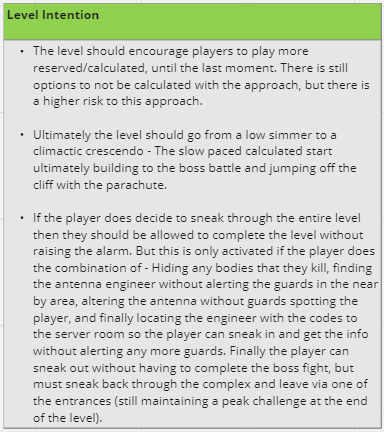
Narrative
With Walker taken care of, and the threat of a third world war thwarted, Nomad can now focus on removing what threats remain on Auroa.
Whilst out on a mission to help reduce the influence of the Sentinel military group, Nomad receives intel that a rogue member of Walker's Wolves has occupied a Skell server base situated on North West side of the mountain side. The Wolves operative, Major Anthony Miller, has taken control of the base and is forcing the engineers who work there to reprogram the drones around the island to do his bidding in an attempt to regain control. Nomad must infiltrate the base, remove the Wolves operatives who are stationed there, reconfigure the antenna to sever Major Miller's connection to the drones, and then connect to the server in order to track any future drone interference.

Engineer with codes for antenna reconfiguration

Engineer with server room door access codes

Water Cooling System control room

Drone control room with Major Miller (Pink) overseeing
Level Design
Throughout the process of creating the level there were several design choices that I decided to make in order to sell the intended gameplay experience.
GYM
I started the process with creating a Gym Level. Within this level I placed different cover heights, enemy types and patrol routes, important 3D assets, weapon types, and individual mechanics.
By outlining aspects such as cover height and climbing height it allows me to quickly place standardised cover objects within the level without having to guess if they are the right height for the intended gameplay. For example, if I want the player to be in a high intensity fast paced shootout I would primarily use low cover to make them feel as though they are more exposed and need to keep moving in order to stay safe.

Gym overview
LANDMARKS
With the level requiring the player to move around an open space in order to complete the objectives it is important that they are able to navigate the level with ease without getting lost.
In order to aid the players navigation I decided to place major landmarks. I wanted to make sure that the player could see the antenna from every entrance. This would provide them with a key landmark right from the beginning of the level, as well as allowing them to quickly find the antenna after they receive the codes from the engineer.

Front Entrance

Side Entrance One

Side Entrance Two
MULTIPLE PLAYSTYLES
Since Ghost Recon provides many mechanics that allow the player to customise how they play the game, I wanted to make sure that multiple play styles were accommodated throughout the level.
One way of achieving this was by having multiple path choices for players, alongside multiple micro paths that would quickly link the macro paths.
There is one path from each entrance that can take the player to the objectives as fast as possible, however, if they deviate off of the fast path they may find alternative ways of completing the level or some loot.
Alongside the multiple paths, each route provides enough cover for stealth gameplay as well as full on combat.
Throughout the map I wanted to provide good line of sight in order to provide gameplay for long ranged sniper style playstyles. However, I didn't want the player to be able to shoot every enemy from one position, so I blocked some of the sighlines with buildings or objects in order to encourage the player to move.

Red = Main Path, Orange = Alternative routes

Sightlines from fire watch tower
VERTICALITY
For me, using height is a key aspect of creating interesting dynamic gameplay. I wanted to make it so that the player will always be climbing up towards combat, especially at the beginning of the level. This is done in an attempt to make the player feel as though they are rising to the challenge of the fight.
However, for the final building, and final fight of the level I wanted the player to feel as though they are delving down into the depths, going towards something secret and underground, hidden away. Until they finally reach the boss fight, at which point they are once again at a disadvantage due to the boss having the height advantage.
Further to the verticality of the buildings, I wanted to provide the player with multiple options when it came to scaling certain aspects of the level. For example, with the raised helipad, I wanted to have it so the player could either go up the stairs or use the crates next to the pad to climb up. This would provide a smooth flow of gameplay across the map, rarely making the player exit an area the way they came in.

Final Boss Building, lower than the rest.
Final Boss Room Iteration
For the final room I wanted have a contrast between the narrow corridor and the open boss fight area. This was in order to get a feeling of claustrophobia, increasing the tension, and then agoraphobia, making the player feel exposed and in the open. However, I was also wanting to balance cover between the player and the boss.
Ultimately I decided to iterate the room so that the player had a variety of options when entering the room. Instead of the player entering the room below the boss, straight into a lot of cover, I wanted to have the player enter at a similar level to the boss but with less cover in order to give the boss the upper hand, but still encourage the player into the room. By adding another level to the room, it also allowed for the room to become more open, really pushing the players vulnerability, making it more appropriate for a boss fight.

Final Boss Room Pre Iteration

Final Boss Room Post Iteration
Player Routes Flythrough